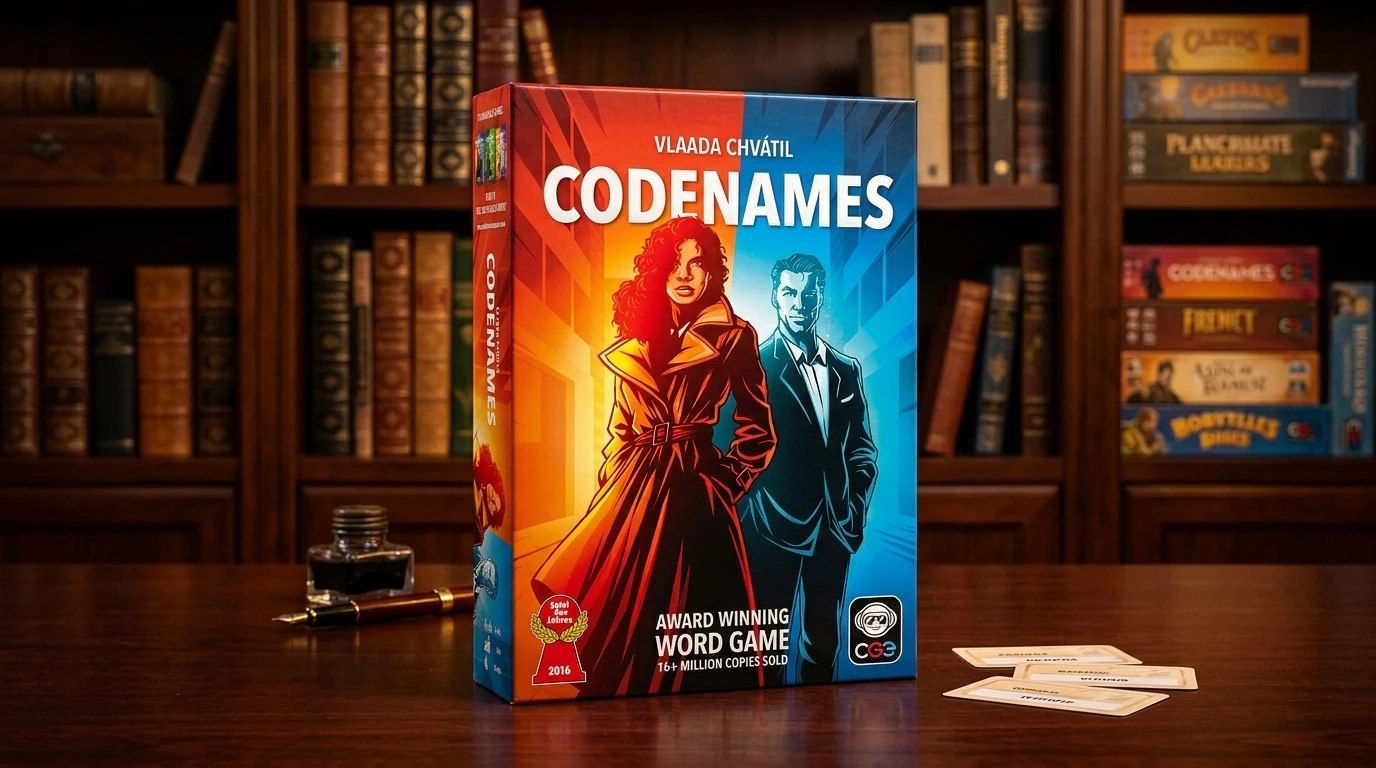
Codename Review
Codename Review
AT A GLANCE
Codenames board game review — Czech Games Edition’s word association party game has a 7.6 rating on BoardGameGeek from over 100,000 players, won the Spiel des Jahres in 2016, and remains one of the most played party games on the planet. The 2nd edition brings refreshed packaging and streamlined rules. The game itself remains untouchable.
Codenames Board Game Review: Ten Years Later, Still the Best Party Game at the Table
Codenames board game review verdict: essential. There are very few games that have earned the word “classic” as quickly or as decisively as Codenames. Designed by Vlaada Chvátil and published by Czech Games Edition, it won the Spiel des Jahres — the most prestigious award in board gaming — in 2016, and has been a fixture on game night tables across the world ever since. The 2nd edition brings updated packaging, refreshed agent card designs, and a streamlined rulebook. The core game is unchanged. It does not need to be. It is simple, but once you play it for the first time you will want to play it again — and especially try taking a turn as the Spymaster. That pull is as strong now as it was a decade ago.
What Is Codenames?
Codenames is a game for two competing teams and a 5×5 grid of random words. The words represent the codenames for your own and enemy agents. One player from each team takes on the role of clue-giver — the Spymaster. The Spymasters know which words they need their own team to identify and which words are targets for the opposing team. They also know which one of the 25 words must be avoided at all costs because it will hand their opponents an instant win if chosen. The Spymasters try to come up with one-word clues that guide their team to, ideally, multiple words simultaneously.
That is the entire game. One word. One number. As many guesses as the number allows. The tension that simple framework generates is remarkable — and it scales beautifully from four players to a full room. The more players you add, the louder and more chaotic the guessing becomes. The debate within a team about what a clue means, the groans when someone picks the wrong word, the triumphant moment when a Spymaster’s clue lands perfectly across three targets — Codenames delivers all of it, every session, without fail.
Affiliate link — we may earn a commission at no extra cost to you.
The Experience
The first game of Codenames requires a single read of the rulebook — and it is a short one. Setup takes two minutes. Rules explanation takes three. Within ten minutes of opening the box, everyone at the table is playing, and within the first round, everyone understands why this game won every award it was nominated for.
The game itself can be highly cognitive, deceptively simple, but stressful for the Spymaster — especially if you are not too familiar with the game. As far as learning goes, it is straightforward. The Spymaster role is where the real depth lives. Constructing a clue that connects three of your words without touching the assassin, the opposing team’s words, or the innocent bystanders requires a kind of lateral thinking that feels genuinely satisfying when it works — and genuinely agonizing when your team completely misses what you were going for.
The sweet spot is four to six players — two teams of two or three, giving each team enough voices to generate the debate and disagreement that makes the guessing phase entertaining. Beyond six players the game scales well — teams simply get larger and louder. Playing with different people brings a different spice that keeps the game interesting. The games always change. A session with close friends who know how each other thinks plays completely differently from a session with new acquaintances — and both versions are worth having.
What Works
The elegance of the design is Codenames’ defining quality. The rules are so simple that explaining them takes minutes, yet the decisions the game asks of the Spymaster are genuinely difficult. That combination — instant accessibility, real cognitive depth — is extraordinarily rare in party games and is the reason Codenames travels as well as it does. It works at family gatherings, at work events, at game nights with dedicated hobbyists, and at parties where most people have never played a board game in their lives.
Codenames is a great game to gather people regardless of setting. It is easy to invite friends and family and build a sense of community — online or in person. The game helps deepen connections with those you are playing with by discovering how teammates think, how they operate, and their perspectives. That social dimension — the way the game reveals how different people’s minds make connections — is what elevates it from a good party game to a genuinely great one.
The 2nd edition’s streamlined rulebook and refreshed components make it the cleanest version of the game available. The new agent card designs add visual variety without changing anything that mattered about the original.
What Doesn’t
The 2nd edition’s most criticized aspect across review communities is that the word cards appear to be largely the same as those in the first edition — the only material differences being updated box art, more variety in agent card design, and the removal of the sand timer. Players who already own the first edition will find very little new content to justify an upgrade purchase. If you own the original, you do not need this version. If you are buying Codenames for the first time, this is the one to get.
The game genuinely requires four players minimum to function at its best. Two-player sessions are possible but lose the team dynamic that makes the guessing phase entertaining. For dedicated two-player households, Codenames Duet — the cooperative variant — is the better purchase.
Verdict
Codenames is the party game benchmark. Every other party game that attempts to combine accessibility with genuine depth gets measured against it — and most fall short. The 2nd edition is the definitive physical version: updated components, streamlined rules, and the same extraordinary game underneath it all.
Buy it if you do not own it. It will become the most-played game in your collection within a month. The learning curve is minimal, the fun is immediate, and the replayability is as high as any game in any category. Once you play it, you will want to play it again — and everyone else at the table will too.f the original — this one has its own thing going on, and that thing is pretty great.
Affiliate link — we may earn a commission at no extra cost to you.
✅ What Works
- Instant accessibility, real cognitive depth — extraordinarily rare in party games
- Works across every group, every setting, every experience level
- Spymaster role generates genuine tension every single session
❌ What Doesn’t
- 2nd edition adds almost nothing for existing owners — don’t double dip
- Needs four players minimum — two-player households should buy Codenames Duet instead