Asmodee HEAT: Pedal to the Metal Review
Asmodee HEAT: Pedal to the Metal Review
AT A GLANCE
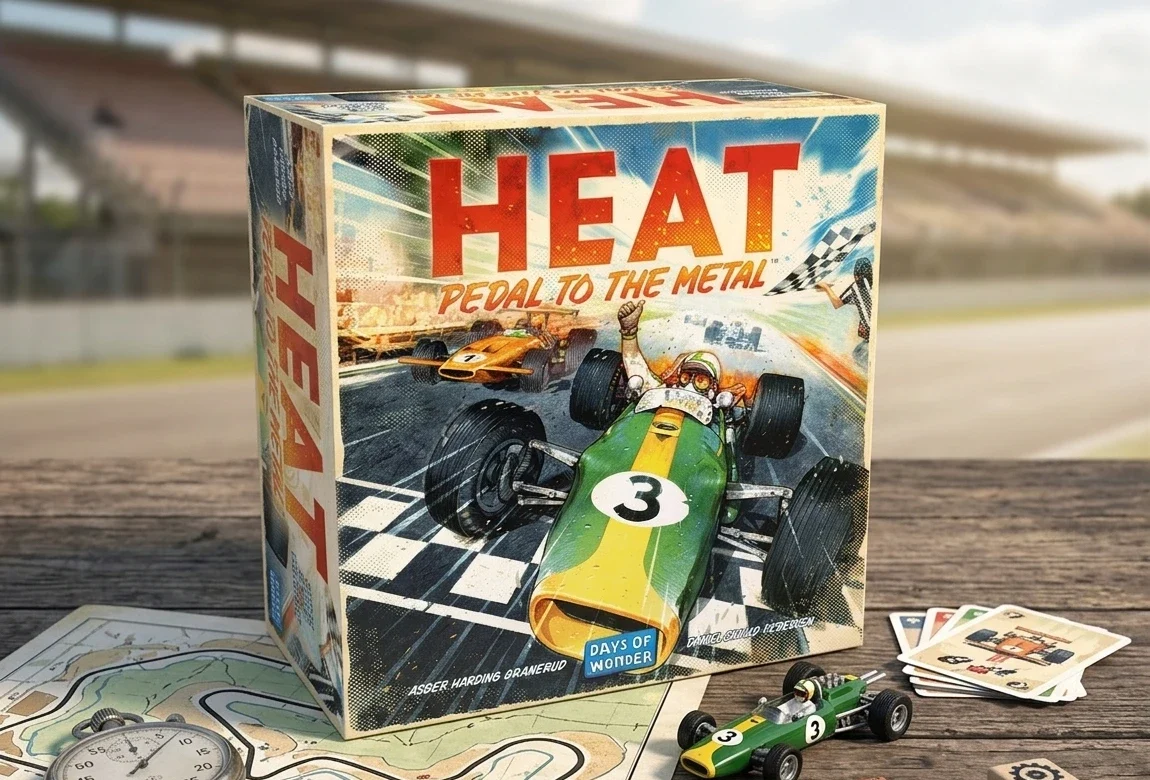
HEAT: Pedal to the Metal is a 1960s Grand Prix racing game for 1 to 6 players from Days of Wonder. You manage a hand of cards to push your car around the track, balance speed against heat buildup, and try not to spin out in the corners. It won the 2022 Golden Geek Medium Game of the Year award, holds an 8.0 rating on BoardGameGeek, and has sold over 500,000 copies worldwide. It is, simply put, one of the best board games released in the last five years.
Pedal to the Metal Review: The Racing Game That Actually Feels Like Racing
Racing games have a long and troubled history in the board game hobby. For every design that captures genuine wheel-to-wheel tension, there are a dozen games that reduce the experience to rolling dice and watching a token inch around a track. HEAT: Pedal to the Metal, designed by the duo behind the beloved cycling game Flamme Rouge and published by Days of Wonder in 2022, is not that game. It sits at an 8.0 on BoardGameGeek, won the 2022 Golden Geek Medium Game of the Year, and has sold over 500,000 physical copies worldwide. The hype is earned.
What Is HEAT: Pedal to the Metal
HEAT drops you into the high-octane world of 1960s Formula 1 racing, a period when safety standards were more of a suggestion than a requirement. Each player manages their own personal deck of speed cards, heat cards, and stress cards. Every round, all players reveal their choices simultaneously. You add up your speed values, move your car that many spaces along the track, and then deal with the consequences of how hard you pushed.
The core tension lives in a single resource: heat. Push your engine too hard in a gear it cannot handle, and your deck fills with heat cards that clog your hand and slow you down in future turns. Manage your heat intelligently, and you can string together clean, fast laps while your opponents are stuck crawling through corners trying to cool their engines down. Slipstreaming adds another layer, granting bonus movement when you end a turn directly behind another car. It is the kind of mechanic that makes a group of adults very invested in where everyone else is sitting on the track.
The Experience
The first game of HEAT requires a single read of the rulebook, which is short. Setup takes about ten minutes once you know the components, and most groups are up and racing within a lap of learning the flow. That accessibility is real, but do not mistake it for shallowness. The decisions the game asks of you are genuinely interesting, particularly around corner management. Corners enforce speed limits. Exceed them and you either take on heat or spin out. Every approach to a tight turn becomes a small calculation: how much speed can you carry, how much heat can you afford, and is the driver behind you about to take advantage of whatever mistake you make.
The game performs best with four to six players. At that count, the slipstreaming dynamic creates a constantly shifting chain of cars and the races feel authentically chaotic in the best possible way. At lower player counts, the included Legends module lets you fill the grid with AI-controlled drivers controlled by a simple card-flip system that is clean, challenging, and surprisingly satisfying. The Championship System, which strings multiple races together in a single game night with car customization and changing weather conditions between events, transforms HEAT from a 60-minute race into a full evening of motorsport drama.
What Works
The heat management system is the standout design achievement. It functions as both a throttle and a punishment mechanism, and the tension of deciding whether to floor it through a tight corner or protect your engine never loses its edge. Every turn has stakes. The components back it up. The two double-sided track boards give you four full Grand Prix circuits. The six plastic race cars are chunky and satisfying to push around. The box insert is thoughtfully designed, making setup and teardown fast enough that you can get a race going without the usual 20-minute component shuffle that slows down heavier games.
Amazon reviewers and the BoardGameGeek community consistently highlight how quickly new players find their footing. Most groups grasp the flow within a lap or two, and the simultaneous play format means nobody sits around waiting for their turn. HEAT is also a genuine must-have for collectors. Days of Wonder built it to last, and the two expansions already released, Heavy Rain and Tunnel Vision, along with a third expansion announced for 2026, signal a publisher committed to keeping this game on tables for years.
What Doesn’t
The track boards are enormous, larger than a standard Monopoly board, and when you add player mats and the Championship or Legends module mats, HEAT demands serious table space. If your gaming setup is tight, plan for it. Some experienced player groups have also noted that races at higher skill levels tend to converge toward similar finishes, with the field bunching up in the final corner and outcomes occasionally coming down to a single card. This is a deliberate catch-up design choice, and for most groups it keeps races exciting rather than lopsided. Players who prefer strict simulation over balanced tension may find it frustrating.
Verdict
HEAT: Pedal to the Metal delivers something the hobby has needed for a long time: a racing game that actually feels like racing. The push-your-luck heat decisions, the slipstreaming tactics, the simultaneous play, and the sheer chaos of six cars screaming toward the same corner all combine into something that earns a permanent spot on the shelf. It works for casual players, dedicated hobbyists, and everyone in between.
Buy it. It will get played more than almost anything else you own, and everyone at the table will want a rematch.nth. The learning curve is minimal, the fun is immediate, and the replayability is as high as any game in any category. Once you play it, you will want to play it again — and everyone else at the table will too.f the original — this one has its own thing going on, and that thing is pretty great.
Affiliate link — we may earn a commission at no extra cost to you.
✅ What Works
- Heat management creates real stakes every turn — push your luck or protect your engine
- Outstanding value — chunky components, four circuits, expansion support built to last
- Simultaneous play means nobody sits around waiting — the whole table is always in the race
❌ What Doesn’t
- Demands serious table space — the track boards are enormous before you add player mats
- High-skill races can converge — outcomes occasionally come down to a single card in the final corner