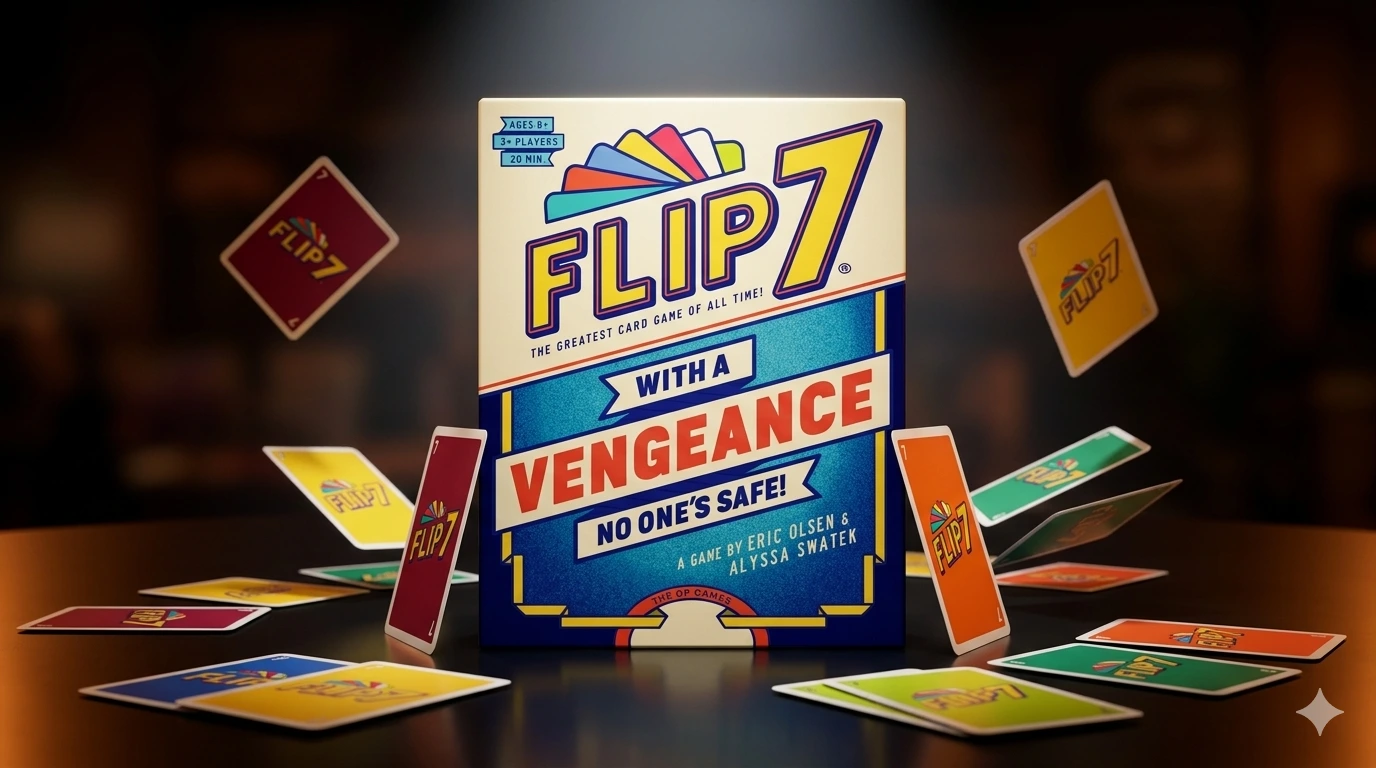
Flip 7: With A Vengeance
Flip 7 with a Vengeance Review
✅ What Works
- The added action cards create stronger player interaction
- It stays quick, easy to learn, and good for groups
- It works well as a more aggressive alternative to the original
❌ What Doesn’t
- The original still feels more polished overall
- The card quality can feel a bit cheap
Title: Flip 7: With A Vengeance
Year Released: 2026
Designers: Eric Olsen, Alyssa Swatek
Publisher: The Op Games
Players: 3–28
Play Time: About 20 minutes
Age Range: 8+
Price Range: Around $10–$16 USD depending on retailer and region.
At a Glance
Flip 7: With A Vengeance takes the core idea of the original Flip 7 and adds a much meaner, more interactive edge. It is still a quick push-your-luck card game, but this version leans harder into action cards, direct attacks, and chaotic table moments, which makes it feel like a sharper and more aggressive sequel.
Introduction
Some sequels try to reinvent the wheel, and others just turn it faster. Flip 7: With A Vengeance lands somewhere in the middle. It clearly wants to build on what made the original work, but it does so by making the game a lot more personal. This is not just another round of trying your luck and hoping not to bust. This time, the deck is ready to mess with everyone at the table.
That shift is what makes this version interesting. If you liked the first Flip 7 because it was light, quick, and easy to teach, there is a good chance this one will still click. But if your group prefers the cleaner, simpler energy of the original, this follow-up may feel a little more chaotic than necessary. That tension is exactly what defines the game.
What Is Flip 7: With A Vengeance?
Flip 7: With A Vengeance is a fast card game from designers Eric Olsen and Alyssa Swatek, published by The Op Games in 2026. It plays 3 to 28 players, takes around 20 minutes, and is recommended for ages 8 and up. It falls into the card game, party game, and push-your-luck category, with mechanics built around score-and-reset play, take-that interaction, and a deck that becomes riskier the longer you stay in.
The hook is simple. Players flip cards one at a time and try not to reveal the same number twice. The deck is uneven by design, with one 1 card, two 2s, three 3s, and so on. That alone gives the game its identity, but this version adds special cards that can cut points in half, steal cards, force draws, and generally create trouble for other players. The goal remains the same familiar race for points, but now the journey there is much nastier.
First Impressions and Component Quality
At first glance, the game does what it needs to do. It looks colorful, approachable, and easy to pull off a shelf for family game night or a casual gathering. Like the original, it is designed to be accessible and fast rather than premium or deluxe. That works for this type of card game, especially at its lower price point.
That said, this is one area where your experience really stands out. You mentioned that this version feels cheaper than the original, especially when it comes to the cards themselves, and that is the kind of thing that matters in a game like this. When a card game lives and dies by constant shuffling, flipping, and handling, component feel becomes part of the experience. Even if the rules are fun, cheaper-feeling cards can make the whole package seem less satisfying than it should.
So while the presentation is clean and functional, this does not sound like a game that leaves a premium first impression. It feels more like a quick retail sequel than a truly upgraded edition.
Setup and Rules
One of Flip 7’s biggest strengths is still how easy it is to get to the table. Setup is minimal, teaching is fast, and most players will understand the basics within minutes. Flip cards, avoid duplicates, decide whether to stop or keep going, and bank points when the timing feels right. That simplicity is a big reason the series works so well.
The complication comes from the new action cards. The official FAQ makes it clear that these cards can chain together, force extra flips, swap cards, and even bust players in unexpectedly brutal ways. That added layer is not hard to learn, but it does make the game a little less clean than the original. Instead of just managing your own risk, you now have to watch the whole table.
For some groups, that will be the entire selling point. For others, it may feel like the sequel added messiness where the original had elegance.
How the Game Feels in Play
This is where your take makes the most sense. You liked that the game becomes more aggressive and less dependent on pure defense or passive luck. That change gives players more ways to affect each other, which naturally creates more laughs, more groans, and more moments where the table gets loud. In a party setting, that is often exactly what you want.
The game also seems to keep players engaged because something can happen to you even when it is not your turn. That is usually a good sign in a light card game. Nobody wants a 20-minute filler where everyone is just quietly doing math and waiting. Flip 7: With A Vengeance sounds far more alive than that.
Still, aggression does not automatically mean improvement. I think your comparison to the original is the most important part of the review. This version is a solid variation, but it may not be the better one. The original seems to have had a smoother identity, while this one trades some of that elegance for sharper interaction. Whether that feels exciting or excessive will depend entirely on the group.
Strategy vs. Luck
Like the original, luck is still a major part of the experience. You are flipping from a deck that can punish you at any moment, and no amount of cleverness removes that. But the added actions do create a little more room for tactical choices. You are not just deciding when to stop. You are also thinking about who to target, when to pressure another player, and how much risk you are willing to take in a more hostile environment.
So the game still leans luck-heavy, but it now carries a stronger interactive strategy layer than before. That is probably the best way to describe it.
Best Player Count and Who It Is For
Because this is such a light and quick card game, it feels best as a casual group title. Even though it technically supports huge player counts, the sweet spot is probably a medium-sized group where the table talk and action cards have room to breathe without becoming total noise. Published information lists it for 3 to 28 players, which makes it easy to bring out at almost any gathering.
This is best for families, casual players, and groups that enjoy take-that games without taking them too seriously. Players who loved the original for its cleaner push-your-luck formula may prefer to keep that one as their main version.
Replay Value
Replay value is solid because the game is short, easy to teach, and naturally unpredictable. The randomness helps keep rounds from feeling identical, and the attack cards create fresh table drama each time. That said, the replay value depends a lot on whether your group enjoys this harsher tone. If they do, this will stay in rotation. If not, it may end up feeling like an alternate version you revisit only occasionally.
Is It Worth It?
At roughly ten to sixteen dollars, Flip 7: With A Vengeance is not a huge risk. It is affordable, fast, and easy to bring out for almost any group.
I think it is worth it for players who already enjoy Flip 7 and want a more aggressive twist. But if you are choosing between the two, your own reaction says it best: this version is fun, it plays well, and it works as a switch-up, yet the original still feels like the stronger design.
Final Thoughts
Flip 7: With A Vengeance is a decent sequel that understands what made the first game popular, but changes the mood enough that it will not replace the original for everyone. It is faster, meaner, and more attack-driven, which gives it a different kind of energy at the table.
In the end, this feels less like the definitive version of Flip 7 and more like the “spicy” version you bring out when your group wants more chaos. That makes it worthwhile, but not essential. A 3 out of 5 feels fair: fun, solid, and easy to enjoy, but not quite as strong or as satisfying as the original. Structured using your uploaded board game template.