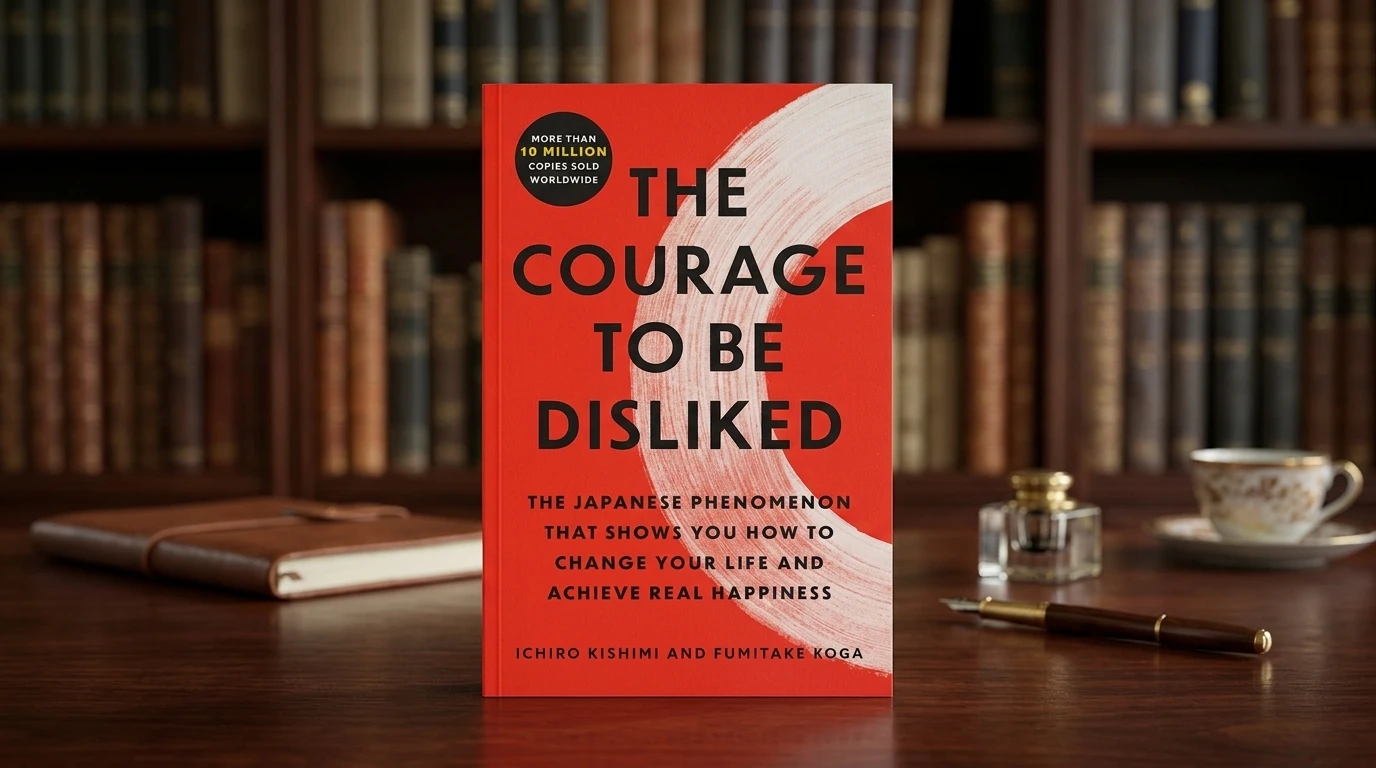
The Courage to Be Disliked: The Japanese Phenomenon
The Courage to Be Disliked Review: The Book That Divides Everyone Who Reads It
AT A GLANCE
The Courage to Be Disliked review — Kishimi and Koga’s Adlerian philosophy book has sold millions of copies worldwide and split readers right down the middle. The ideas are genuinely powerful. The format will test your patience. Here is the honest verdict.
The Courage to Be Disliked Review: One of the Most Polarizing Self-Help Books You’ll Ever Read
The Courage to Be Disliked review verdict: read it, but know what you’re walking into. This is not a comfortable self-help book. It does not offer affirmations, action plans, or morning routines. What it offers is a philosophical argument — structured as a five-night conversation between a skeptical young man and an Adlerian philosopher — that your unhappiness is a choice, your past does not define you, and that freedom begins the moment you stop seeking the approval of others. That premise has resonated with millions of readers worldwide and alienated just as many. Both reactions are understandable. Both are honest responses to a book that refuses to flatter you.
What Is The Courage to Be Disliked?
The Courage to Be Disliked is a conversation that unfolds over five non-consecutive nights between a skeptical young man and a wise philosopher, who introduces him to the ideas of Alfred Adler — one of the big names in psychology, but far less doom-and-gloom than Freud. Each chapter tackles a different theme: identity, relationships, freedom, belonging, and purpose, with the philosopher slowly debunking everything the young man thinks he knows about happiness and success.
The core argument is Adlerian psychology distilled to its most confrontational point: all problems are interpersonal problems, your lifestyle is a choice you made and can remake, and the courage to be disliked — to live according to your own principles regardless of others’ approval — is the path to genuine freedom. The book was originally published in Japan, became a multi-million copy bestseller across Asia, and arrived in English translation to the same combination of devoted fans and sharp critics it generated everywhere else.
Affiliate link — we may earn a commission at no extra cost to you.
The Experience
The concept behind this book is unapologetic: happiness is a choice, and you can choose it right now — not once you quit your job, not once your boss finally respects your boundaries, and not once you hit some checkbox version of success that everyone else decided for you. You just need the courage to let go of all the things keeping you stuck.
That framing lands differently depending on where you are in life. For readers who feel genuinely trapped by people-pleasing, approval-seeking, or the weight of past experiences, the book functions as a permission slip — a philosophical argument that the gap between who you are and who you want to be is a courage problem, not a circumstance problem. Those readers tend to find the book transformative and return to it repeatedly. Some readers have bought all formats of it and reread it multiple times, finding new breakthroughs with each reading.
For readers who arrive expecting practical tools, the book is a different experience. The lack of practical examples can lean the book toward a more esoteric series of platitudes.The dialogue format — student pushes back, philosopher responds, student pushes back again — is deliberately Socratic, but it tests patience. Many readers report finding the young man’s repeated skepticism repetitive rather than useful. The audiobook version, at eight hours of two people debating Adlerian theory, is specifically noted as a challenging listen.
What Works
The ideas are the book’s strength and they are genuinely worth engaging with. The distinction between self-affirmation and self-acceptance — the difference between performing confidence and meeting yourself honestly where you actually are — is articulated with more clarity here than in most Western self-help books. The concept of “tasks” — that other people’s reactions to your choices are their task to manage, not yours — is a big theme that stays with readers long after finishing.
The book’s Adlerian framework, drawing on one of Freud and Jung’s contemporaries who rejected trauma-as-destiny thinking, offers a genuinely different lens from most psychology-adjacent self-help. Whether you fully accept the framework or not, the challenge it presents to the way most people think about their own limitations is valuable. Many readers find themselves still thinking about the book weeks later, questioning what they learned and examining how much of it can reframe how they see the world.
The dialogue format, for readers who click with it, creates an accessible entry point into philosophy that a traditional essay format would not. The young man’s objections mirror the reader’s objections, which makes each philosophical reframe feel earned rather than asserted.
What Doesn’t
The book’s most controversial claim — that trauma from the past has no direct influence over present behavior, and that choosing unhappiness is something we do actively rather than passively — is where public opinion splits most sharply. This position can read as victim blaming: the idea that if you are unhappy, it is because you have chosen unhappiness. For readers who have experienced genuine trauma, this framing is not just unconvincing — it is actively alienating. It is the most consistent criticism across Amazon, Goodreads, and review communities, and it is a fair one. The book presents Adlerian psychology as truth rather than as one perspective among many, and that absolutism will close doors for readers who need more nuance.
The title itself misleads some readers — because even though being disliked might be the general punchline of the book, it does not spend very much time addressing that specifically. Readers who pick it up expecting a practical guide to handling social disapproval will find a much broader philosophical argument than the title suggests.
Verdict
The Courage to Be Disliked earns its reputation as one of the most discussed self-help books of the past decade — not because it is universally beloved, but because it is genuinely challenging. The ideas push back against the way most people think about happiness, freedom, and the influence of the past. Some readers will find those ideas transformative. Others will reject the framework entirely and feel the book earns its criticism.
What is not in dispute is that the book makes you think. It raises questions about approval-seeking, interpersonal competition, and the courage to live according to your own values that stay with you past the last page. For a self-help book, that is exactly the job — and The Courage to Be Disliked does it well enough to recommend, with the caveat that you come prepared for philosophy, not a productivity plan.
Read it with a critical eye. Take the framework as a tool, not a verdict. And if the dialogue format starts to drag, push through — the ideas in the back half justify the patience required to get there.
Affiliate link — we may earn a commission at no extra cost to you.
✅ What Works
- Adlerian ideas are genuinely different — a real alternative to standard self-help
- The approval-seeking and “tasks” framework stays with you past the last page
- Provocative enough to make you question things you thought were settled
❌ What Doesn’t
- Dialogue format tests patience — the young man’s repetition wears thin
- Presents Adlerian theory as truth, not perspective — the absolutism closes doors